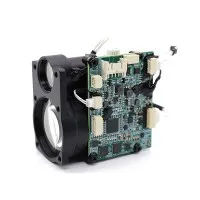

Hey there! As a supplier of Cooled Camera Modules, I often get asked about the image compression formats these modules support. So, I thought I'd take some time to break it down for you.


First off, let's understand why image compression is so important for cooled camera modules. These cameras are often used in high - end applications like scientific research, military surveillance, and industrial inspections. The data they generate can be massive, especially when capturing high - resolution thermal images at a high frame rate. Compression helps to reduce the amount of data that needs to be stored and transmitted, without sacrificing too much on image quality.
One of the most commonly supported compression formats is JPEG (Joint Photographic Experts Group). JPEG is a lossy compression format, which means it discards some of the image data to reduce file size. It's a great choice for applications where a small loss in image quality is acceptable in exchange for significant space savings. For example, in long - range surveillance, where you're mainly interested in detecting and identifying large objects, a JPEG - compressed image can work just fine. You can learn more about the differences between cooled and uncooled cameras for long - range applications here: Cooled Versus Uncooled Cameras for Long Range.
Another format that our cooled camera modules support is PNG (Portable Network Graphics). Unlike JPEG, PNG is a lossless compression format. This means that no data is lost during the compression process, and the decompressed image is an exact copy of the original. PNG is ideal for applications where image quality is of the utmost importance, such as in scientific research where accurate data analysis is required. For instance, when studying thermal patterns in a chemical reaction, a lossless PNG image can provide the most accurate data.
TIFF (Tagged Image File Format) is also an option. TIFF is a flexible format that can support both lossy and lossless compression. It's widely used in the professional imaging industry because it can store a large amount of metadata along with the image. This metadata can include information about the camera settings, the time of capture, and other details that can be crucial for post - processing and analysis.
Now, let's talk about some of the more specialized compression formats. For example, our cooled camera modules also support H.264 and H.265, which are video compression standards. These are great for applications where you need to record continuous thermal video. H.264 is a well - established standard that offers good compression ratios and is widely supported by most devices. H.265, on the other hand, is the next - generation standard that provides even better compression efficiency, which means you can store more video data in less space.
If you're looking for a compact and efficient option for your cooled camera module, you might want to check out our Cooled Ir Camera Module. It's designed to support multiple compression formats, giving you the flexibility to choose the one that best suits your needs.
In addition to these mainstream formats, there are also some proprietary compression formats that we've developed in - house. These formats are optimized specifically for our cooled camera modules, offering a balance between high - quality image preservation and efficient data compression. They're particularly useful for customers who have unique requirements or who are working in specialized fields.
When it comes to choosing the right compression format, it really depends on your specific application. If you're short on storage space and don't need the absolute highest image quality, a lossy format like JPEG or H.264 might be the way to go. But if image accuracy is crucial, then a lossless format like PNG or TIFF would be a better choice.
We also offer a Mini Thermal Camera that's perfect for applications where size and portability are important. Despite its small size, it still supports a wide range of image compression formats, allowing you to capture and store high - quality thermal images on the go.
If you're in the market for a cooled camera module and have questions about the image compression formats or any other features, don't hesitate to reach out. We're here to help you find the perfect solution for your needs. Whether you're a researcher, a military professional, or an industrial inspector, our team of experts can guide you through the selection process and ensure that you get the most out of your camera module.
In conclusion, the image compression formats supported by our cooled camera modules offer a wide range of options to meet the diverse needs of our customers. From lossy formats for space - saving to lossless formats for high - quality data, we've got you covered. So, if you're ready to take your thermal imaging to the next level, let's start a conversation about how our products can fit into your workflow.
References
- General knowledge about image compression formats in the imaging industry
- Technical specifications of our cooled camera modules