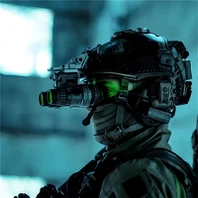


Laser rangefinder has become one of the core technologies in the field of modern measurement due to its high precision, fast response and strong anti-interference ability. From military reconnaissance to consumer electronics, from industrial automation to autonomous driving, it is everywhere. This article will deeply analyze the working principle, technical classification, core components, application scenarios and future development trends of laser rangefinder, and give you a comprehensive understanding of this key technology.

1. Basic Principles of Laser Distance Measurement
The basic function of a laser rangefinder is to accurately calculate the distance between a target object and a measuring instrument through the propagation and reflection process of laser light. According to different distance measurement methods, laser distance measurement can be divided into the following three principles:
1. Time of Flight (ToF)
The ToF principle is one of the most classic methods in the distance measurement system. It calculates the distance by measuring the flight time of the laser from emission to target and then back. Its mathematical model is:
Distance = speed of light × time / 2
For example, in a building facade scan, the ToF system can obtain distance data of tens of thousands of points within a few seconds to achieve high-precision modeling. Due to its wide range of applications (ranging from a few meters to a few kilometers), it is particularly important in scenarios such as drone inspections, military reconnaissance, and radar mapping.
2. Phase difference ranging method
This method is mainly suitable for medium and short distance measurements. Its accuracy is usually higher than ToF and is suitable for millimeter-level distance measurement requirements. The laser signal is transmitted after modulation, and the receiving end calculates the optical path difference by comparing the phase difference between the transmitted wave and the returned wave, and finally obtains the target distance. Due to its fast measurement speed and high accuracy, it is widely used in industrial positioning systems and smart home space modeling.
3. Triangulation method
This method is mainly used for short-distance measurement and relies on the geometric triangle relationship formed between the laser transmitter, receiver and target point. The advantage of triangulation is that its ranging resolution is high, which can reach the micron level, and is suitable for high-precision industrial manufacturing, PCB inspection and robot visual recognition.
2. Core components of laser rangefinder
The performance of laser rangefinder is highly dependent on the coordinated work of its internal modules. The key modules are as follows:
1. Laser emission module
This module is the "light source" of the laser rangefinder system, and mostly uses laser diodes in the 905nm or 1550nm band. Compared with 905nm, 1550nm laser not only performs better in terms of human eye safety, but also has stronger penetration, suitable for use in harsh environments such as strong light, high humidity, and high dust.
Lasers are divided into two categories:
Pulse laser: used in ToF system, with high-energy short pulse output;
Continuous wave laser: commonly used in phase difference system, easy phase modulation and demodulation.
2. Optical system
The transmitting lens focuses the laser beam and reduces the divergence angle;
The receiving lens collects as much reflected light as possible to improve the receiving sensitivity of the system;
Infrared filter is used to shield stray visible light and sunlight to improve anti-interference ability.
3. Photodetector
APD has high gain characteristics and is suitable for long-distance measurement;
SPAD has extremely high sensitivity and is often used for ultra-long-distance distance measurement or distance measurement in dark environments.
4. Signal processing unit
Use high-performance TDC to calculate flight time, and cooperate with DSP or FPGA for high-speed data processing and filtering, compensation and other algorithms to achieve accurate real-time feedback.
5. Auxiliary system
IMU compensates for errors caused by rangefinder vibration;
GPS/RTK is used in combination to achieve high-precision positioning, such as common in surveying and agricultural drones.
3. Application scenarios of laser rangefinders
1. Military and security
In tactical operations, laser rangefinders are widely used in sniping, target locking, drone reconnaissance and missile guidance. They can integrate ballistic calculation systems to achieve the integration of "ranging-aiming-shooting", greatly improving shooting accuracy and efficiency.
2. Surveying and GIS
Total stations and laser radar (LiDAR) play a key role in urban planning, mine surveying, forest resource statistics and other fields. The laser system can quickly generate topographic maps and three-dimensional models, and upload them to the GIS platform in real time for decision-making analysis.
3. Industrial automation
In systems such as high-precision assembly lines, robot visual positioning, and warehouse logistics automatic guide vehicles (AGVs), laser rangefinders provide dynamic positioning support. For example, a large manufacturing company uses laser sensors to monitor product errors and increase the yield rate to more than 98%.
4. Autonomous driving and intelligent transportation
As the core component of the perception system of autonomous vehicles, laser radar can realize real-time modeling of the surrounding environment, dynamic target detection and path planning. Combined with cameras and millimeter-wave radars, it forms a full-dimensional safety perception system.
5. Consumer electronics and sports
Laser focus systems are widely used in smartphones to improve shooting speed and accuracy; golf rangefinders help players grasp the distance of shots in real time; sweeping robots use laser navigation to build high-precision maps to improve cleaning efficiency.

4. Future development trends
1. Solid-state laser radar
Traditional laser radar relies on mechanical rotating structures. Solid-state radar achieves contactless scanning through MEMS micromirrors, OPA optical phased arrays, etc., which improves reliability and reduces costs. It is expected to be widely used in autonomous driving and robots.
2. Multi-sensor fusion
The laser ranging system is integrated with infrared thermal imaging, cameras, millimeter-wave radars, etc. to improve system robustness. At night or in extreme weather conditions, the fusion perception system can maintain stable output.
3. Intelligence and AI processing
With the help of AI algorithms and edge computing technology, laser ranging data can identify objects, track dynamic targets, and predict path changes in real time. For example, in smart warehousing, laser navigation systems combine AI visual algorithms to achieve unmanned sorting.
4. Miniaturization and low-power design
With the development of chip packaging and silicon photonics technology, laser ranging modules are moving towards a size of "fingernail size", and can be widely used in lightweight scenes such as AR glasses, smart watches, and drones in the future.
5. Infrared fusion technology helps distance measurement - Hangzhou Huirui Technology Co., Ltd.
With the increasing maturity of multi-sensor fusion technology, infrared thermal imaging is becoming a powerful supplement to laser distance measurement. Since its establishment in 2013, Hangzhou Huirui Technology Co., Ltd. has been focusing on the development of infrared thermal imaging core technology and laser rangefinder and the implementation of solutions, and is committed to building a world-leading infrared intelligent perception service platform.
As a national high-tech enterprise, Hangzhou Huirui Technology Co., Ltd. is headquartered in Hangzhou, China, with service outlets in 27 cities around the world, and 50 delivery centers provide all-weather technical support in more than 200 languages, covering military industry, industrial automation, power inspection, forest fire prevention, border monitoring and other industries.
Its main product, infrared thermal imager, can be seamlessly integrated with the laser distance measurement system to enhance the anti-interference ability of target recognition and distance measurement system. At night or in extremely low visibility environments, Hangzhou Huirui Technology Co., Ltd.'s infrared technology can help drones accurately identify obstacles and detect heat sources, and is widely used in forest fire early warning, border security patrols, smart city construction and other fields.
In addition, Hangzhou Huirui Technology Co., Ltd. also provides customized services and can develop exclusive modules according to the needs of different industries to help customers build intelligent, efficient and safe ranging and perception systems.
6. Conclusion
As the cornerstone of intelligent perception systems, laser ranging technology is rapidly penetrating into all walks of life. Driven by artificial intelligence, edge computing and multi-sensor fusion technologies, its application boundaries are constantly expanding. From high-precision industrial manufacturing to autonomous driving to personal consumer terminals, laser rangefinders are leading a revolution in "precision and intelligence". Companies like Hangzhou Huirui Technology Co., Ltd., which have infrared sensing and global service capabilities, will play an increasingly important role in this transformation, enabling various industries to move towards a smarter future.