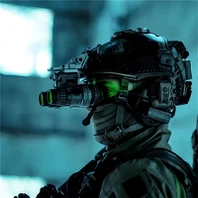


In a dim or even pitch-dark environment, thermal imaging monoculars open a window for us to "see temperature". Whether it is special forces performing missions at night, firefighters entering a smoke-filled fire scene, or biologists observing animals in the wilderness, thermal imaging equipment plays an indispensable role. But how do these devices work? Why can they "see" things that our eyes cannot see? What advanced technologies and practical applications are driving the continuous development of this field? This article will give you a comprehensive analysis of the working mechanism and application prospects of thermal imaging monoculars.

1. What is a thermal imaging monocular?
A thermal imaging monocular is a portable optical device, usually designed as a single eye, that can generate images by detecting infrared radiation. This device does not rely on visible light, so it can still effectively image in the dark, foggy, rainy and snowy environments.
Compared with traditional night vision devices, thermal imaging devices do not require any light source and are not afraid of strong light interference, which makes it an ideal tool for dealing with harsh environments.
2. How thermal imaging works: the technology of visible "heat"
The core of thermal imaging technology lies in sensing and processing infrared radiation. All objects with temperatures above absolute zero emit infrared radiation. Thermal imaging equipment captures these invisible heat energy signals through special sensors and converts them into images visible to the naked eye.
1. Infrared radiation perception
Infrared can be divided into near-infrared, mid-infrared and far-infrared according to wavelength. Thermal imaging usually works in the far-infrared band of 8 to 14 microns, which is the area with the strongest thermal radiation. Compared with visible light, this type of wavelength can penetrate smoke and dust, so the imaging ability is stronger.
2. Focal plane array
FPA is the core component of thermal imaging equipment, equivalent to a "thermal camera". It consists of thousands to hundreds of thousands of micro-detection units, each of which is responsible for recording one pixel in the image. The current mainstream materials are vanadium oxide and amorphous silicon, which are highly sensitive and have a fast response speed.
3. Signal processing and image generation
The thermal signal collected by FPA is converted into an electrical signal through an analog-to-digital converter, and then the processor generates a thermal map based on different temperature distributions. Usually, the image is displayed in black and white or pseudo-color, making it easier for users to distinguish temperature differences.

3. Key technical indicators of thermal imaging monocular
1. Resolution
The clarity of thermal imaging is determined by the resolution of the infrared detector. Common specifications include 160x120, 320x240, and 640x480 pixels. The higher the resolution, the finer the image, but the more expensive it is.
2. Thermal sensitivity
Noise Equivalent Temperature Difference indicates the minimum temperature difference that the device can distinguish. The lower the value, the better. Generally, civilian products are around 50mK, and military equipment is even lower than 30mK.
3. Refresh rate
The unit is hertz, which represents the number of times the image is updated per second. Common ones are 9Hz (civilian export restrictions), 30Hz, 50Hz or higher (military or industrial use). The higher the refresh rate, the smoother the image.
4. Detection distance
Affected by the focal length of the lens and the sensitivity of the sensor, some devices can detect human heat sources 1,000 meters away. This is especially important when used for search and rescue or border monitoring.
4. Typical application scenarios
1. Military and law enforcement
Special forces, border defense forces, and patrol police use thermal imaging equipment to identify enemy targets and track suspicious persons in the dark, greatly improving nighttime combat and reconnaissance capabilities.
2. Firefighting and rescue
The fire scene is filled with smoke, and ordinary vision is almost ineffective. Thermal imaging monoculars can quickly locate trapped people and identify overheated equipment, improving rescue efficiency and safety.
3. Wildlife observation and hunting
Observing animals in the wild or hunting at night, thermal imaging equipment allows users to perform efficient detection without disturbing animals.
4. Building and industrial inspection
Thermal imaging can be used to detect heat loss in buildings, overload of power systems, overheating of motors or bearings, and is an important tool for maintenance and energy saving.
5. Medical and public health (temperature screening)
During the epidemic, thermal imaging technology was widely used for temperature monitoring in crowded places such as airports and stations to detect feverish people as soon as possible.
5. Hangzhou Huirui Technology Co.,Ltd
As a high-tech enterprise deeply engaged in infrared thermal imaging technology, Huirui is committed to becoming the world's leading custom thermal monoculars manufacturer. The company has a core R&D team composed of infrared sensor experts, imaging algorithm engineers and optical structure designers, focusing on developing high-performance, modular and integrated thermal imaging solutions, which are widely used in security monitoring, industrial detection, power inspection, medical diagnosis, artificial intelligence and autonomous driving and other key industries.
Huirui provides one-stop services from sensor selection, image algorithm optimization, hardware customization, software integration to whole machine structure design, and can tailor thermal imaging products that meet different resolutions, frame rates, field of view, power consumption and packaging requirements according to customers' application scenarios. Whether it is an ultra-miniaturized thermal imaging module or an intelligent thermal imaging terminal with deep AI recognition capabilities, Huirui can respond quickly and provide highly reliable customized solutions.
As an enterprise focusing on technology accumulation and product innovation, Huirui actively participates in the formulation of national infrared standards and has passed ISO9001 quality management system certification and multiple CE and RoHS international certifications. The company's products are not only sold well in China, but also exported to global markets such as Europe, North America, and Southeast Asia, winning high praise from many industry customers.
Huirui has always adhered to the development concept of "precise imaging and intelligent future", driven by core thermal imaging technology, to help build a safer, more efficient, and smarter world. Whether you are a hardware manufacturer looking for an embeddable infrared module or a solution provider who needs an AI thermal recognition platform, Hangzhou Huirui Technology Co.,Ltd will be your trusted strategic partner.
6. Advantages and limitations of thermal imaging monoculars
Advantages:
Available all day: not dependent on light source, clear imaging in darkness, thick smoke, rain and fog;
Not affected by strong light: unlike night vision devices, strong light will not interfere with imaging;
Strong concealment: passive imaging, no light source, not easy to be discovered;
Strong target recognition ability: thermal characteristics can be used to determine whether it is a person, animal or mechanical equipment.
Limitations:
High price: high-end thermal imaging equipment is expensive;
Unable to penetrate glass: infrared rays cannot effectively penetrate glass, and observation of objects behind windows will be limited;
Lower resolution than optical devices: although excellent in perception, detailed imaging is still slightly inferior;
High power consumption: high refresh rate and high-definition screens place high demands on battery life.
7. Future Trend Outlook
AI Intelligent Recognition: Combine artificial intelligence to identify human, animal, and vehicle, and improve the accuracy of discrimination;
Multi-band fusion technology: Integrate visible light, thermal imaging, and laser ranging to build a panoramic perception system;
Augmented Reality (AR) Integration: Superimpose thermal images on the real world to improve user experience;
Miniaturization and integration: Used in smart wearable devices, drones, smart helmets and other fields.
8. Conclusion
Thermal imaging monocular telescope represents the advanced technology of "sensing the world with heat". It transcends the limitations of visible light and provides unprecedented insight for humans in many fields such as battlefields, fires, forests, buildings and medical care. Through the continuous development of sensor technology, image processing algorithms and cross-border integrated applications, it is becoming more accurate, smarter and more popular.
As shown by innovative companies such as Pfizer, the combination of technology with health and safety is driving the world into a new era of intelligent perception. Thermal imaging equipment is not only a "night vision tool", but also an important part of future human-machine collaboration and smart environment construction.
No matter how deep the darkness is, the "thermal eyes" of technology will eventually light the way for us.