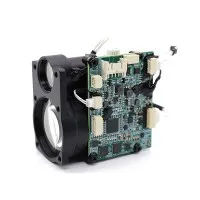

The pixel pitch of a cooled IR camera is a crucial parameter that significantly impacts its performance and application suitability. As a leading supplier of Cooled IR Cameras, we understand the importance of this technical specification and its implications for our customers. In this blog post, we will delve into the concept of pixel pitch, its significance, and how it relates to the capabilities of our Cooled Infrared Camera Core, Cooled Camera Modules, and Cooled Ir Camera Core.


Understanding Pixel Pitch
Pixel pitch refers to the distance between the centers of two adjacent pixels in an infrared (IR) detector array. It is typically measured in micrometers (μm). A smaller pixel pitch means that more pixels can be packed into a given area, resulting in a higher pixel density. Conversely, a larger pixel pitch indicates fewer pixels per unit area.
The pixel pitch of a cooled IR camera plays a vital role in determining several key performance characteristics, including spatial resolution, thermal sensitivity, and the overall size and cost of the camera.
Impact on Spatial Resolution
Spatial resolution is the ability of a camera to distinguish between two closely spaced objects. It is often expressed in terms of the minimum resolvable temperature difference (MRTD) or the noise equivalent temperature difference (NETD). A smaller pixel pitch generally leads to better spatial resolution because it allows the camera to capture finer details.
When the pixel pitch is small, the camera can detect smaller temperature variations in the scene, enabling it to resolve smaller objects. This is particularly important in applications such as surveillance, where the ability to identify small targets at a distance is crucial. For example, in border surveillance, a cooled IR camera with a small pixel pitch can detect the presence of intruders more accurately, even in low-light or adverse weather conditions.
On the other hand, a larger pixel pitch may limit the camera's ability to resolve fine details. However, it can also have some advantages in certain applications. For instance, in long-range thermal imaging, a larger pixel pitch can provide a wider field of view, which may be more important than high spatial resolution.
Influence on Thermal Sensitivity
Thermal sensitivity is another critical performance parameter of a cooled IR camera. It refers to the camera's ability to detect small temperature differences in the scene. A smaller pixel pitch can enhance thermal sensitivity because it allows the camera to capture more infrared radiation per pixel.
When the pixel pitch is small, each pixel can collect more photons, resulting in a higher signal-to-noise ratio (SNR). This means that the camera can detect smaller temperature changes with greater accuracy. In applications such as industrial inspection, where the detection of small temperature variations can indicate potential defects or malfunctions, a cooled IR camera with high thermal sensitivity is essential.
However, it's important to note that thermal sensitivity is also influenced by other factors, such as the detector material, the cooling mechanism, and the optical design of the camera. Therefore, a small pixel pitch alone does not guarantee high thermal sensitivity.
Size and Cost Considerations
The pixel pitch of a cooled IR camera also has implications for its size and cost. A smaller pixel pitch generally requires more advanced manufacturing techniques and materials, which can increase the cost of the detector array. Additionally, a smaller pixel pitch may require more complex signal processing electronics to handle the large amount of data generated by the high-resolution image.
As a result, cooled IR cameras with smaller pixel pitches tend to be more expensive and may have a larger physical size. This can be a limiting factor in some applications, especially those where size and cost are critical considerations.
On the other hand, a larger pixel pitch can result in a more cost-effective and compact camera design. This makes it a more suitable choice for applications where size and cost are more important than high spatial resolution or thermal sensitivity.
Our Cooled IR Camera Offerings
At our company, we offer a range of cooled IR cameras with different pixel pitches to meet the diverse needs of our customers. Our Cooled Infrared Camera Core is designed to provide high performance and reliability in a compact and lightweight package. It features a small pixel pitch for excellent spatial resolution and thermal sensitivity, making it ideal for applications such as surveillance, industrial inspection, and scientific research.
Our Cooled Camera Modules are pre-integrated solutions that offer a convenient and cost-effective way to incorporate cooled IR imaging technology into your products. They are available with different pixel pitches and configurations to suit various application requirements.
For customers who require a more customized solution, we also offer Cooled Ir Camera Core products that can be tailored to specific performance and size requirements. Our experienced engineering team can work closely with you to develop a solution that meets your exact needs.
Conclusion
In conclusion, the pixel pitch of a cooled IR camera is a critical parameter that affects its spatial resolution, thermal sensitivity, size, and cost. A smaller pixel pitch generally provides better spatial resolution and thermal sensitivity but may also result in a higher cost and larger physical size. Conversely, a larger pixel pitch can offer a wider field of view and a more cost-effective solution, but it may sacrifice some spatial resolution and thermal sensitivity.
As a leading supplier of Cooled IR Cameras, we understand the importance of choosing the right pixel pitch for your application. Our team of experts can help you select the most suitable camera based on your specific requirements and budget. Whether you need high spatial resolution, excellent thermal sensitivity, or a combination of both, we have the right solution for you.
If you are interested in learning more about our cooled IR camera products or have any questions about pixel pitch or other technical specifications, please feel free to contact us. We look forward to discussing your needs and providing you with the best possible solution.
References
- Smith, J. (2018). Infrared Imaging Systems: Design and Analysis. Wiley.
- Jones, A. (2019). Thermal Imaging Technology: Principles and Applications. Springer.
- Brown, C. (2020). Advanced Infrared Detectors and Systems. CRC Press.