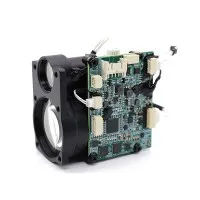

Hey there! As a supplier of LWIR Camera Cores, I often get asked about the output format of these nifty devices. So, let's dive right in and break it down in a way that's easy to understand.
First off, what exactly is an LWIR camera core? LWIR stands for Long - Wave Infrared. These camera cores are designed to detect the infrared radiation in the long - wave part of the spectrum, typically around 8 - 14 micrometers. This ability allows them to "see" heat, which has a whole bunch of practical applications, from security and surveillance to industrial inspections and even in the medical field.
Now, onto the output format. The output format of LWIR camera cores can vary, and it mainly depends on the specific requirements of the end - user and the application they're using the camera for.
One of the most common output formats is digital. Digital outputs are super popular because they're easy to work with in modern systems. They can be directly connected to a computer, a microcontroller, or other digital devices. For example, many of our Miniature Uncooled Infrared Camera Cores come with a digital output. The digital data can be in different protocols, such as USB, Ethernet, or Camera Link.


USB is a widely used interface because it's simple and almost every computer has a USB port. It's great for quick and easy data transfer, especially for applications where you just want to view the thermal image on a computer. You can plug the camera core into your laptop, and within seconds, you'll be able to see the heat signatures in front of the camera.
Ethernet, on the other hand, is more suitable for long - distance data transfer and high - speed applications. If you're setting up a large - scale surveillance system where the camera core is located far away from the control center, Ethernet can ensure that the data gets transmitted quickly and reliably.
Camera Link is a high - performance interface that's often used in industrial and scientific applications. It can handle large amounts of data at very high speeds, which is crucial when you need to capture detailed thermal images in real - time.
Another important output format is analog. Analog outputs are still used in some older systems or in applications where simplicity is key. An analog output typically provides a voltage or current signal that corresponds to the intensity of the infrared radiation detected by the camera core. This signal can then be processed by an analog - to - digital converter (ADC) if you want to use it in a digital system.
Some of our Uncooled Camera Cores offer analog outputs for customers who prefer this traditional approach. Analog outputs are relatively straightforward and don't require a lot of complex electronics to interface with. However, they do have some limitations. For instance, the signal can be affected by noise and interference over long distances, and the resolution might not be as high as digital outputs.
In addition to the digital and analog outputs, there are also specialized output formats for specific applications. For example, in the field of thermal imaging for research purposes, you might need a camera core that can output raw data. Raw data gives you the most detailed information about the infrared radiation detected by the camera. It contains all the unprocessed information, which can be useful for advanced analysis and algorithm development.
Our LWIR Micro Thermal Camera Module can be configured to output raw data for customers who are involved in such research projects. With raw data, you can perform your own calibration, filtering, and other processing steps to get the most accurate and detailed thermal images.
When it comes to image formats, most LWIR camera cores can output images in standard formats like JPEG or BMP. These formats are widely supported by image - viewing software, making it easy for you to share and analyze the thermal images. Some camera cores also support more advanced image formats, such as TIFF, which can store high - resolution and high - quality images with additional metadata.
The choice of output format also depends on the processing power available. If you have a powerful computer or a dedicated processing unit, you can handle more complex output formats and larger amounts of data. On the other hand, if you're using a low - power microcontroller, you might need to choose a simpler output format that doesn't require a lot of processing resources.
So, as you can see, there are several factors to consider when it comes to the output format of LWIR camera cores. Whether you need a digital output for easy integration with modern systems, an analog output for simplicity, or a specialized output for research, we've got you covered.
If you're in the market for LWIR camera cores and have specific requirements regarding the output format, don't hesitate to reach out to us. We can help you choose the right camera core that meets your needs and provide you with all the technical support you need. Whether it's for a small - scale project or a large - scale industrial application, we're here to assist you every step of the way.
Let's work together to find the perfect LWIR camera core solution for your business. Contact us today to start the conversation about your procurement needs and let's get your project up and running!
References:
- Various technical specifications of LWIR camera cores from our product development team.
- Industry research on thermal imaging technology and output formats.