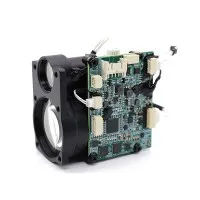

Hey there! As a supplier of Cooled IR Cameras, I've been getting a lot of questions lately about how the cooling process affects the performance of these nifty devices. So, I thought I'd take a deep dive into this topic and share some insights with you.
First off, let's talk about what a Cooled IR Camera is. In simple terms, it's a camera that can detect infrared radiation, which is basically heat. These cameras are super useful in a bunch of fields, like security, surveillance, industrial inspection, and even scientific research. Unlike uncooled IR cameras, cooled ones have a cooling system that helps them operate at lower temperatures.
Now, you might be wondering, "Why does cooling matter?" Well, the cooling of a Cooled IR Camera has a huge impact on its performance. Let's break it down into a few key areas.
Sensitivity
One of the most important aspects of an IR camera is its sensitivity. Sensitivity refers to how well the camera can detect small differences in temperature. A cooled IR camera can achieve much higher sensitivity compared to an uncooled one. This is because the cooling system reduces the thermal noise in the detector.
Thermal noise is basically random fluctuations in the electrical signals generated by the detector due to its own heat. When the detector is cooled, these fluctuations are minimized, allowing the camera to pick up even the slightest changes in infrared radiation. This means that a cooled IR camera can detect very small temperature differences, which is crucial in applications where precision is key, like detecting early signs of equipment failure in an industrial setting.
For example, in a power plant, a cooled IR camera can detect a small increase in temperature in an electrical component, which could indicate a potential problem. By catching these issues early, maintenance can be scheduled before a major breakdown occurs, saving time and money.
Resolution
Another important factor is resolution. Resolution refers to the number of pixels in the camera's detector. A higher resolution means that the camera can capture more detailed images. Cooling plays a role in improving resolution as well.
When the detector is cooled, the individual pixels can operate more efficiently. This allows for better signal-to-noise ratio, which in turn leads to sharper and more detailed images. In applications like surveillance, a high-resolution cooled IR camera can provide clear images of objects even in low-light or complete darkness.
Let's say you're using a cooled IR camera for border security. The high resolution allows you to clearly identify people and vehicles from a distance, making it easier to detect any potential threats.
Response Time
Response time is also affected by the cooling of a Cooled IR Camera. Response time refers to how quickly the camera can detect and respond to changes in temperature. A cooled IR camera has a faster response time compared to an uncooled one.
This is because the cooling system helps to stabilize the detector's temperature, allowing it to respond more quickly to changes in infrared radiation. In applications where fast detection is required, like in military or aerospace applications, a fast response time can be a game-changer.
For instance, in a military surveillance mission, a cooled IR camera with a fast response time can quickly detect the movement of enemy troops or vehicles, giving the military an edge in the field.
Spectral Range
The spectral range of an IR camera refers to the range of infrared wavelengths that the camera can detect. Cooling can also have an impact on the spectral range of a Cooled IR Camera.
A cooled detector can operate at a wider spectral range compared to an uncooled one. This is because the cooling system reduces the thermal noise, allowing the detector to detect infrared radiation at longer wavelengths. In applications like scientific research, a wide spectral range can be very useful for studying different types of materials and phenomena.
For example, in astronomy, a cooled IR camera with a wide spectral range can be used to study distant stars and galaxies, providing valuable insights into the universe.
Longevity and Reliability
Finally, the cooling of a Cooled IR Camera can also affect its longevity and reliability. A well-cooled camera is less likely to experience thermal stress and damage, which can extend its lifespan.


The cooling system helps to keep the detector at a stable temperature, reducing the risk of overheating and component failure. This means that a cooled IR camera can provide reliable performance over a long period of time, making it a cost-effective investment in the long run.
In an industrial environment, where cameras are often exposed to harsh conditions, a reliable cooled IR camera can save a lot of money on replacement and maintenance costs.
So, as you can see, the cooling of a Cooled IR Camera has a significant impact on its performance. Whether it's sensitivity, resolution, response time, spectral range, or longevity and reliability, cooling plays a crucial role in making these cameras so effective in a wide range of applications.
If you're in the market for a high-performance IR camera, I highly recommend considering a cooled one. At our company, we offer a range of Cooled Infrared Camera Core, Ir Camera Core, and Cooled Thermal Imaging Core that are designed to deliver top-notch performance.
If you have any questions or are interested in learning more about our products, feel free to reach out. We'd be happy to discuss your specific needs and help you find the perfect IR camera for your application. Let's start a conversation and see how we can work together to meet your requirements.
References
- "Infrared Thermal Imaging: Fundamentals, Research and Applications" by Paul Reuter
- "Thermal Imaging Handbook" by Bob Jones