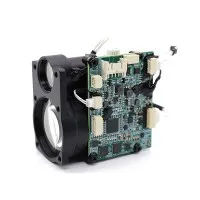

As a supplier of LWIR (Long-Wave Infrared) Camera Cores, I've witnessed firsthand the remarkable advancements in infrared technology and its applications. One of the most intriguing aspects of LWIR camera cores is their ability to handle moving objects effectively. In this blog post, I'll delve into the science behind how LWIR camera cores manage to capture and analyze moving targets, exploring the key technologies and strategies involved.
Understanding LWIR Technology
Before we dive into the specifics of handling moving objects, let's briefly review what LWIR technology is and how it works. LWIR cameras operate in the long-wave infrared spectrum, typically between 8 and 14 micrometers. This part of the spectrum is particularly useful for thermal imaging because it allows the camera to detect the heat emitted by objects, regardless of lighting conditions. Unlike visible light cameras, which rely on reflected light, LWIR cameras can see in complete darkness, making them ideal for a wide range of applications, including surveillance, security, and industrial inspection.
Challenges of Capturing Moving Objects
Capturing moving objects with LWIR camera cores presents several challenges. One of the primary challenges is the relatively slow frame rate of many LWIR cameras. Frame rate refers to the number of images or frames that a camera can capture per second. A lower frame rate means that the camera may miss some details or movements between frames, resulting in a blurry or choppy image. This can be particularly problematic when trying to track fast-moving objects or when high-resolution images are required.
Another challenge is the motion blur caused by the movement of the object or the camera itself. Motion blur occurs when the object moves during the exposure time of the camera, causing the image to appear smeared or out of focus. This can make it difficult to identify the object or to analyze its features accurately.
Technologies and Strategies for Handling Moving Objects
To overcome these challenges, LWIR camera core manufacturers have developed several technologies and strategies. Here are some of the most common ones:
High Frame Rate Cameras
One of the most effective ways to handle moving objects is to use a high frame rate camera. High frame rate cameras can capture more frames per second, reducing the chances of missing details or movements between frames. This results in a smoother, more accurate image of the moving object. At our company, we offer a range of Uncooled Camera Cores with high frame rates, allowing our customers to capture fast-moving objects with ease.
Electronic Image Stabilization (EIS)
Electronic Image Stabilization (EIS) is a technology that helps to reduce motion blur caused by the movement of the camera or the object. EIS works by analyzing the movement of the image between frames and applying algorithms to compensate for the movement. This can help to keep the image steady and reduce the appearance of motion blur. Many of our Miniature Uncooled Infrared Camera Cores are equipped with EIS technology, providing our customers with clear, sharp images even when the camera or the object is in motion.
Adaptive Integration Time
Adaptive Integration Time is a technique that allows the camera to adjust the exposure time based on the movement of the object. When the object is moving slowly, the camera can use a longer exposure time to capture more light and detail. When the object is moving quickly, the camera can use a shorter exposure time to reduce motion blur. This helps to ensure that the image is clear and sharp, regardless of the speed of the object. Our Thermal Imaging Module is designed with adaptive integration time technology, providing optimal performance in a variety of conditions.
Object Tracking Algorithms
Object tracking algorithms are software algorithms that can automatically detect and track moving objects in the image. These algorithms use a variety of techniques, such as feature extraction, motion analysis, and pattern recognition, to identify and track the object. Once the object is identified, the algorithm can adjust the camera's settings, such as the focus and the exposure, to ensure that the object remains in focus and well-lit. Our LWIR camera cores are equipped with advanced object tracking algorithms, allowing our customers to track moving objects with high accuracy and reliability.
Applications of LWIR Camera Cores in Tracking Moving Objects
The ability to handle moving objects effectively makes LWIR camera cores ideal for a wide range of applications. Here are some examples:
Surveillance and Security
In surveillance and security applications, LWIR camera cores can be used to monitor large areas and detect the movement of people or vehicles. The high sensitivity and long-range capabilities of LWIR cameras make them particularly useful for detecting intruders in low-light or nighttime conditions. The ability to track moving objects allows security personnel to quickly identify and respond to potential threats.
Industrial Inspection
In industrial inspection applications, LWIR camera cores can be used to monitor the movement of machinery and equipment. By detecting changes in temperature or movement, LWIR cameras can help to identify potential problems before they cause a breakdown or failure. The ability to handle moving objects allows for real-time monitoring and analysis of industrial processes.
Automotive Safety
In automotive safety applications, LWIR camera cores can be used to detect pedestrians, animals, and other objects on the road. The ability to see in complete darkness and to track moving objects makes LWIR cameras an important tool for improving driver safety. By providing early warning of potential hazards, LWIR cameras can help to prevent accidents and save lives.
Conclusion
In conclusion, handling moving objects is a critical aspect of LWIR camera core technology. By using high frame rate cameras, electronic image stabilization, adaptive integration time, and object tracking algorithms, LWIR camera cores can effectively capture and analyze moving targets in a variety of applications. As a supplier of LWIR camera cores, we are committed to providing our customers with the latest technology and solutions to meet their needs. If you are interested in learning more about our products or have any questions about how our LWIR camera cores can handle moving objects, please don't hesitate to contact us for a procurement discussion.


References
- "Infrared Technology and Applications XXXVIII," Proceedings of the SPIE, Volume 8706, 2013.
- "Thermal Imaging: Fundamentals, Research, and Applications," by Manoj K. Mandal, CRC Press, 2015.
- "Advanced Image Processing and Machine Vision," by Michael S. Lew, Wiley, 2016.