


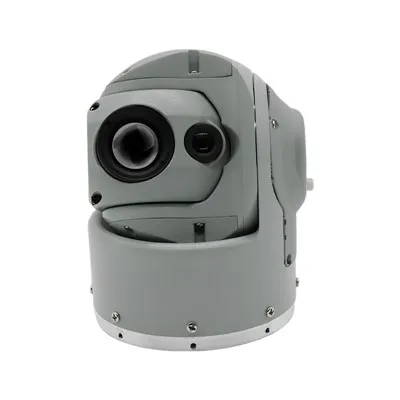
What is the difference between IR and EO cameras?
Imaging Principle
• IR (Infrared) cameras detect thermal radiation emitted by objects.
• EO (Electro-Optical) cameras capture reflected visible light using CMOS or CCD sensors.
• IR imaging is independent of ambient light; EO imaging depends on available illumination.
Spectral Bands
• IR cameras operate in infrared ranges such as NIR, MWIR, or LWIR for thermal detection.
• EO cameras operate in the visible spectrum (approximately 400–700 nm).
• IR provides temperature-based contrast; EO provides color and structural detail.
Environmental Adaptability
• IR cameras function in darkness, smoke, haze, fog, and low-visibility conditions.
• EO cameras perform optimally under daylight or stable artificial lighting.
• IR overcomes obscurants where visible light is insufficient; EO provides clarity when illumination is adequate.
Image Characteristics
• IR outputs thermal imagery showing heat signatures, temperature differences, and thermal anomalies.
• EO outputs high-resolution visual images with texture, color, and fine detail.
• IR images have limited detail compared with EO; EO images cannot show thermal information.
Operational Strengths and Limitations
• IR strengths: night performance, thermal detection, human/vehicle heat identification, search in degraded environments.
• IR limitations: lower spatial detail, no color information, reduced suitability for fine-detail inspection.
• EO strengths: high resolution, color identification, accurate visual classification, daytime surveillance.
• EO limitations: reduced or no performance in darkness or heavy obscurants.
Use-Case Orientation
• IR is suited for night surveillance, search and rescue, perimeter protection, thermal inspection, and detection through obscurants.
• EO is suited for daytime monitoring, identification tasks, documentation, and applications requiring accurate visual detail.
• When tasks span day/night or variable environments, combining IR and EO is required.
EO/IR Combined Systems
• EO/IR systems integrate visible-light and thermal sensors into one payload.
• Combined imaging provides both structural detail and thermal information.
• Dual-band capability supports continuous surveillance, target recognition, industrial inspection, and long-range monitoring.
• EO/IR fusion increases reliability in multi-environment, multi-time-of-day missions.