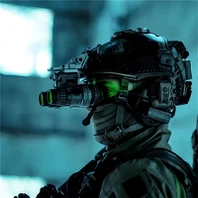


In the vast field of night sky observation, the right observation equipment is crucial. With its unique technical advantages, the thermal imaging monoculars of Hangzhou Huirui Technology Co., Ltd. bring a new observation experience for astronomy enthusiasts.

1. Core advantages of thermal imaging monoculars
Full dark environment adaptability: Traditional optical devices often struggle to function in the dark, and Huirao's thermal imaging monoculars do not rely on visible light, relying on the object's own infrared radiation imaging. In the dark night without moon and stars, it can keenly capture the infrared light emitted by celestial bodies, so that those hidden in the dark celestial bodies have nowhere to hide, opening a new window to the mysterious night sky for observers.
Long-range detection strength: Its strong infrared detection capability makes it excellent in long-range observation. Whether it is a faint heat signal in a distant galaxy, or the heat trail of an asteroid in the solar system, it can be accurately locked. For example, in the observation of some faint objects located at the edge of the Milky Way, the thermal imaging monoculars can break through the distance limit, and their thermal characteristics can be clearly presented to the observer, greatly expanding the scope of the observable universe.
Severe weather penetration: Foggy, smoky weather has been a nightmare for astronomical observations, but this telescope has no problem dealing with it. Its infrared rays can penetrate these obstructing media and maintain stable observation performance in cloudy weather conditions. For example, in foggy environments such as mountains, when ordinary optical telescopes fail due to fog, thermal imaging monoculars can continue to provide clear thermal images of celestial bodies to observers, ensuring that observation activities are not interfered with by weather.
Temperature field visualization insight: The unique temperature field visualization function is another highlight. By visualizing the temperature differences on the surface of celestial bodies, observers can discover some special thermal structures on the surface of celestial bodies. For example, when observing sunspot activity, we can not only see the position and shape of the sunspot, but also understand its internal energy activity through the change of temperature field, which provides an important visual basis for the study of astrophysical processes.
2. Product features and highlights
State-of-the-art thermal imaging technology integration: Advanced high-resolution infrared detectors with industry-leading pixel density and sensitivity. The detector is able to respond quickly and capture weak infrared signals, and after sophisticated signal processing and image algorithm optimization, it generates clear and delicate thermal imaging images, ensuring that the observer will not miss any subtle thermal features of the celestial body.
Multiple observation mode switching: equipped with a variety of observation modes, such as different thermal sensitivity adjustment modes and color display modes. When observing objects in different temperature ranges or adapting to different observation environments, users can flexibly switch according to their needs. For example, when observing hot stars, a highly sensitive observation mode can be selected to highlight their details; When observing cold interstellar dust clouds, a mode suitable for low-contrast targets is switched to enhance the layers and sharpness of the image.
Rugged Quality assurance: The housing is made of high-strength, corrosion-resistant materials with excellent water, dust and shock resistance. Whether it is in the wet seaside, sand-infested desert or rugged mountain observation, it can ensure that the internal precision components are not damaged, stable and reliable operation, providing a solid guarantee for long-term field observation activities.
Convenient and portable design concept: pay attention to the portability of products under the premise of ensuring performance. The overall design is compact and reasonable, and the weight is moderate, which is convenient for the observer to carry to any ideal observation site. Whether it's a short observation trip to the countryside or a long trek to a remote astronomical observation destination, it's easy to pack it in and explore the night sky anytime, anywhere.


3. Applicable to observation scenario analysis
New help for astronomical observation: In conventional astronomical observation, for those cities or suburbs with serious light pollution, thermal imaging monoculars have become a powerful tool for discovering faint objects. It filters out most of the interference from artificial light sources and focuses on the thermal radiation of celestial bodies, allowing observers to see more stars, nebulae and galaxies in the light pollution background. For example, when observing from the roof of a tall building in the center of a city, with the help of thermal imaging monoculars, observers may find some Messier objects obscured by light pollution, enriching the observation results.
Satellite tracking skills: In satellite observation, thermal imaging monoculars with its high sensitivity to moving objects detection ability and fast tracking performance, can timely capture the satellite in orbit when the heat changes. Both low-orbit Earth observation satellites and high-orbit communications satellites can leave clear thermal tracks in their field of view. Through long-term observation and recording, enthusiasts can understand the operation laws and orbital characteristics of satellites, and even find some abnormal thermal phenomena of satellites, providing private observation data support for space research.
4. Comparison and analysis with traditional astronomical telescopes
Light dependence difference: Traditional astronomical telescopes mainly rely on visible light for imaging, in the case of low light or total darkness at night, the observation ability will be greatly reduced. Thermal imaging monoculars get rid of this limitation, using infrared radiation imaging, but in the dark environment can play a greater advantage, providing continuous observation ability for the observer.
Complementary viewing angles: Traditional astronomical telescopes have profound technical accumulation and advantages in observing the optical details of celestial bodies, and can present the rich colors and textures of celestial bodies. Thermal imaging monoculars focus on the thermal characteristics and temperature distribution of celestial bodies, and the two observation perspectives complement each other. When looking at Jupiter, for example, telescopes allow us to see Jupiter's atmospheric streaks and moons, while thermal imaging monoculars reveal the thermal activity inside Jupiter, helping us get a more complete picture of the gas giant.


5. Purchase decision guides
For night sky watchers, whether to choose thermal imaging monoculars needs to consider many factors. From the point of view of advantages, it undoubtedly brings a new dimension and possibility for observation activities, especially in the special environment and observation target has a unique advantage. However, its relatively high price may put off some budget-conscious enthusiasts.
For beginners, budget-friendly infrared equipment can be used as a starting point to experience the charm of infrared technology in night sky observation and develop interest and skills. With further exploration of night sky observation, if you are pursuing a more advanced and professional observation experience, investing in Huiruo's high-end thermal imaging monoculars, especially with advanced light intensifier tubes and telescope accessories, will be able to unlock more observing fun and discovery.
In short, the thermal imaging monoculars of Hangzhou Huirui Technology Co., Ltd. have a value and potential that can not be ignored in the field of night sky observation, which provides a unique and powerful observation tool for astronomy enthusiasts, and is expected to become a useful partner in exploring the mysteries of the universe.
FAQ
1. How do thermal imaging monoculars work?
Thermal imaging monoculars use infrared detectors and optical imaging objectives to receive the infrared radiation energy distribution pattern of the target to be reflected on the photosensitive elements of the infrared detector, so as to obtain infrared thermal images, which correspond to the heat distribution field on the surface of the object. In simple terms, it is to detect the infrared radiation emitted by the object to image, the infrared radiation intensity of different temperature objects is different, and after processing, different images can be displayed on the display.
2. What is the difference between its imaging principle and that of ordinary optical telescopes?
Ordinary optical telescopes make images by collecting and focusing visible light, relying on the visible light reflected or emitted by objects. The thermal imaging monoculars are based on the infrared radiation imaging of the object itself, which does not rely on visible light, and can work even in a completely dark environment, mainly reflecting the temperature distribution of the object.
3. In what scenarios are thermal imaging monoculars suitable for use?
It is suitable for a variety of scenarios, such as outdoor exploration, field search and rescue, security monitoring, military reconnaissance and astronomical observation. Outdoor adventures can help identify terrain and spot potential hazards; In the field search and rescue can quickly find trapped people; Security monitoring can be used for night monitoring; Military reconnaissance can detect enemy targets; Astronomical observations can reveal thermal features of celestial bodies that are difficult to observe with conventional optical telescopes.
4. How does it perform in bad weather?
Thermal imaging monoculars have better performance in bad weather. Because infrared has a certain penetration ability, in fog, rainy, snow and other weather conditions, it is relatively small affected, can still detect the thermal signal of the target object to a certain extent, compared with ordinary optical telescopes have obvious advantages. However, as weather conditions deteriorate, the detection may become less effective, but it often still provides valuable information.
5. Are thermal imaging monoculars easy to operate?
In general, modern thermal imaging monoculars are designed to be user-friendly and relatively simple to operate. There are usually some basic operation buttons for switching the machine on and off, adjusting the focal length, switching the observation mode, adjusting the brightness contrast, and so on. Most of the products have intuitive displays and menu interfaces, and users can master the basic operation methods after simple training and familiarity. But for some high-end products with complex functions, it may take more time to learn and master all its functions.
6. How to maintain thermal imaging monoculars?
Collisions and falls should be avoided to prevent damage to the internal precision components. After use, clean the dust and stains on the surface in time, and wipe with a clean and soft cloth. When not in use for a long time, it should be stored in a dry and ventilated environment to avoid moisture and corrosive gases. In addition, it is necessary to regularly check the battery power and the performance of the equipment, if there is a problem, timely repair or maintenance.