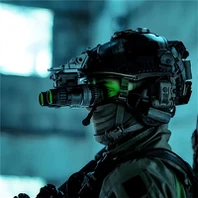


Infrared thermal imaging technology, with its unique ability to capture thermal radiation from objects, has revolutionized the field of camera applications. This technology, which operates based on the fundamental principle that all objects above absolute zero emit infrared radiation, offers distinct advantages in various scenarios. From enabling non-contact temperature measurement to providing clear imaging in challenging environments like darkness, smoke, and fog through its penetration of specific "atmospheric windows", it addresses critical needs in low-illumination and concealed monitoring. This introduction sets the stage to explore in detail the principles, integration with cameras, technical parameters, application scenarios, development trends, and the offerings of Huirui Technology in this domain.
Principles and Characteristics of Infrared Thermal Imaging Technology

Core Principles
Infrared thermal imaging technology realizes imaging based on the thermal radiation characteristics of objects.
In nature, all objects with a temperature higher than absolute zero (-273℃) emit infrared radiation, and the energy of the radiation is directly related to the surface temperature of the object.
By detecting the difference in infrared radiation between the target and the background, an infrared image reflecting the temperature distribution can be generated.
Key Characteristics
This technology has two key characteristics:
First, it supports non-contact temperature measurement and thermal state analysis, providing technical means for industrial testing, energy management, etc.;
Second, it has penetrability to infrared radiation in the 3-5 microns and 8-14 microns bands, enabling clear imaging in environments without light, smoke, rain and fog. These two bands are called "atmospheric windows".
Integration of Infrared Thermal Imaging Technology and Cameras

Integration Advantages
The combination of infrared thermal imaging technology and cameras solves the needs of low illumination and concealed monitoring.
Traditional active infrared monitoring equipment relies on infrared lamps or lasers as light sources, which are easy to be exposed and have high energy consumption;
Thermal imaging cameras based on passive infrared technology do not require visible light, can work in zero-illumination environments, and have concealment at the same time.
Workflow
Its working principle is as follows:
Focus the infrared energy of the object on the infrared detector through the optical system;
The detector converts the infrared data into a standard video format, generates a thermal image and outputs it to a display or storage device.
Equipment Type Selection
At present, uncooled infrared thermal imagers are mostly used in the security field:
Although their sensitivity is lower than that of cooled ones;
They have simple structure, high reliability and low cost, and can meet the needs of most civil and some military scenarios.
Technical Parameters and Functions of Infrared Thermal Imaging Cameras
Core Parameters
The core parameters of infrared thermal imaging cameras include detection distance and power consumption.
Taking the lens with a focal length of 14.3mm as an example, the maximum detection distance can reach 780 meters;
When the focal length is increased to 100mm, the detection distance can be extended to 4400 meters;
In terms of power consumption, the power of its infrared thermal imaging module is about 1.5W, which is much lower than that of active infrared equipment (more than 30W), and has significant energy-saving advantages.
Main Functions
In terms of functions:
It supports 360° continuous rotation, automatic flipping and 0.01°-100°/S speed adjustment, enabling precise tracking;
Equipped with preset positions, automatic scanning, automatic tracking and other functions, suitable for diversified monitoring scenarios;
It also supports multiple video output formats and gain control to ensure imaging stability.
Application Scenarios of Infrared Thermal Imaging Cameras

Indoor Scene Application
In indoor scenes:
It is widely used in administrative centers, bank vaults, confidential rooms, prisons and other places, which can monitor 24 hours a day and analyze background temperature changes to timely warn of abnormal situations;
In the monitoring of important machinery and equipment, it can predict faults by detecting temperature changes, avoiding production interruptions or safety accidents caused by equipment failure.
Outdoor Scene Application
In outdoor scenes:
Its ability to penetrate rain and fog can ensure target monitoring at night and in harsh weather, and is suitable for border control, oil fields, forests and other areas;
In fire prevention monitoring, it can penetrate smoke to identify hidden fires and accurately locate the ignition point and range;
In concealed target detection, it can distinguish the thermal radiation differences between human bodies, vehicles and the natural environment, and detect camouflaged targets in grass and woods.
Development Trends of Infrared Thermal Imaging Technology
Technical Upgrade Directions
In the security field, the development of infrared thermal imaging technology shows four directions:
First, reduce the cost of detectors through new technologies and processes, and promote the overall price reduction of equipment;
Second, improve the pixel and sensitivity of the detector, optimize the imaging resolution and detection distance;
Third, develop variable infrared zoom lenses to enhance scene adaptability;
Fourth, expand the integration application with other products, such as combining with intelligent analysis systems to realize automatic early warning, or integrating with drones and robots to expand the monitoring range.
Infrared Thermal Imaging Technology and Products of Huirui Technology

Huirui Technology (https://www.huirui-ir.com/) has been deeply engaged in the field of infrared thermal imaging for many years, and its technologies and products are closely in line with the development trend of the industry. The company focuses on the research, development and production of infrared thermal imaging cameras. Its products cover various models suitable for different scenarios. In terms of core parameters, they have excellent detection distance and low power consumption characteristics, which can meet the monitoring needs of various indoor and outdoor fields. At the same time, its products integrate advanced infrared thermal imaging technology, with the characteristics of precise tracking and diversified monitoring functions, which can achieve strong concealment, stable and reliable monitoring effects, and provide high-quality infrared thermal imaging solutions for the security monitoring field.